Why a Bicycle Stays Upright: Balance, Wheels, and Friction
This general learning guide offers a simple physics explanation of how a bicycle works. A bike looks almost impossibly stable, yet it can roll forward while you relax your grip and look ahead. The secret is not one magic force. It is a quiet partnership between balance, wheels, steering, and friction.
Balance begins with the rider and the center of mass
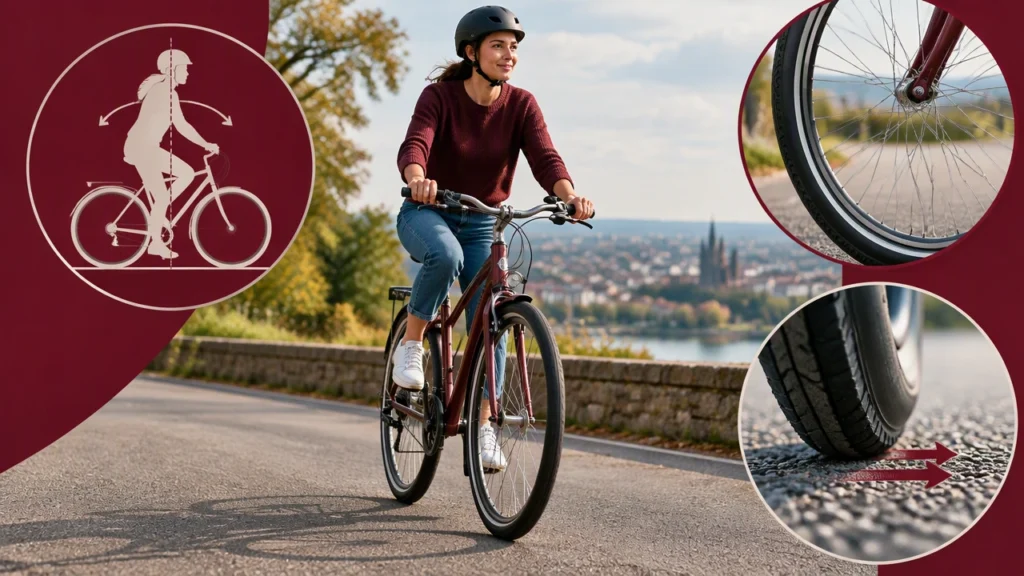
When you sit on a bicycle, you and the bike form one combined system. The center of mass is the average location of all that mass. If the system leans to one side, gravity pulls that center of mass downward in an arc. Without correction, the bike would fall.
Small leans are normal. You constantly make tiny corrections with your body. A slight shift of your hips, a light turn of the handlebars, or a small move of a knee can move the center of mass back over the line between the two tire contact patches. At low speed, these corrections are easy to feel. At higher speed, the wheels and steering can help more.
Why the wheels matter
A bicycle has two wheels in line, so it is narrow from side to side. That makes balance feel delicate. Each wheel is a rotating ring with spokes and a hub. When the wheel spins, its mass is moving in a circle. A spinning wheel resists changes to its orientation, but this effect is modest on a normal bicycle. It is not the main reason the bike stays upright.
Gyroscopic effect
As a wheel spins, it has angular momentum. Push the wheel sideways, and the resulting motion can turn it slightly rather than simply toppling it. This is the gyroscopic effect. It becomes stronger with faster spinning and heavier wheel rims. On a typical bicycle, it helps, but engineers have built bikes with counter-spinning wheels that cancel the effect and they can still balance. Treat gyroscopic motion as one helper, not the whole story.
Trail and self-steering
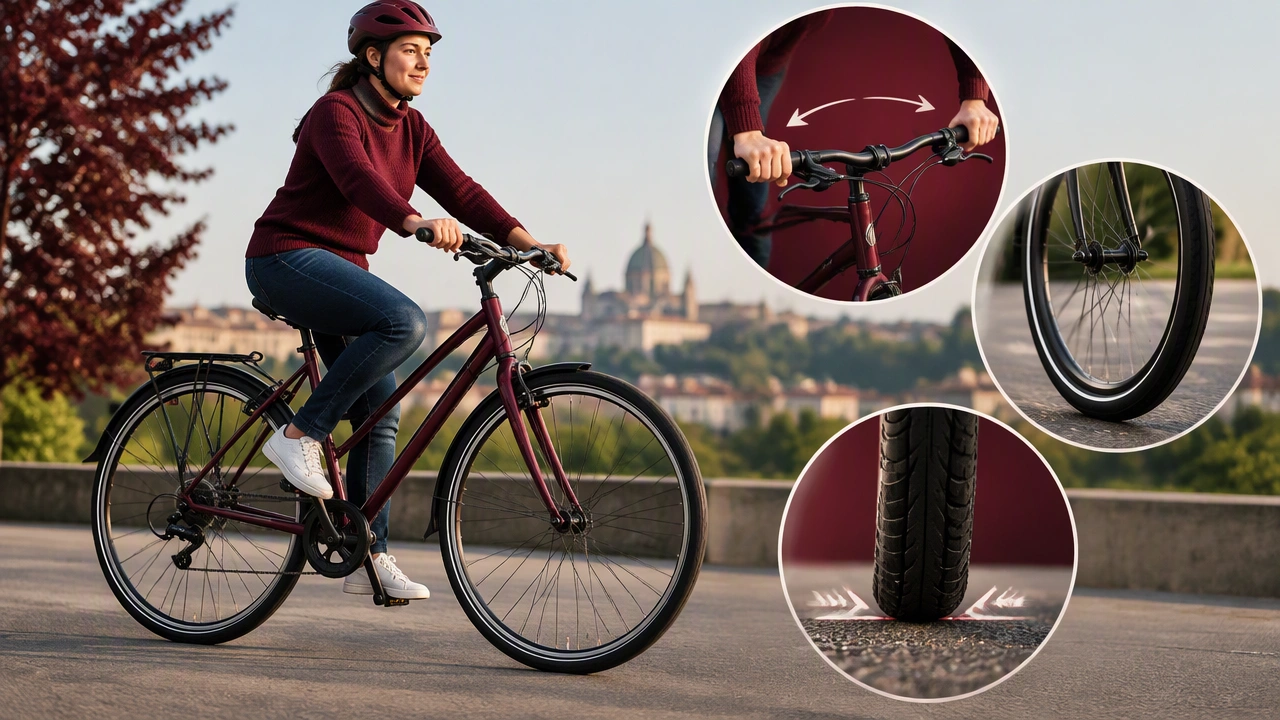
Look at the front fork from the side. The tire touches the ground at one point, while the steering axis meets the ground a little farther forward. The horizontal distance between those points is called trail. Positive trail places the front wheel slightly ahead of the steering line.
When the bike leans, gravity and the forces at the tire create a turning moment around the steering axis. The front wheel turns into the lean. That steering motion moves the contact patch toward the side that is falling, which helps bring the center of mass back over the base. This is called self-steering or caster action. It is one reason a bicycle can feel stable without constant steering input from the rider.
Steering is part of balancing
Balancing a bicycle is not just about staying straight. To recover from a lean, you steer under the falling mass. Imagine the bike tipping to the left. A small turn to the left moves the wheels toward the left, so the ground support moves back beneath the center of mass. The bike rises again. If you steer too far or too quickly, the correction becomes a wobble. Smooth, small inputs work best.
At very low speed, the wheel effects are weak, so you steer more actively and may place a foot down. At moderate speed, the combination of steering geometry and your body movements handles most corrections. At high speed, the same small correction can feel stronger because the wheel forces are larger.
Friction makes motion and control possible
Friction is the force that resists sliding between surfaces. It is not an enemy of motion; without it, tires would spin in place and brakes would do nothing.
Rolling and grip
A tire does not slide forward as it rolls. Instead, the rubber deforms slightly at the contact patch and then recovers. The road pushes back on the tire, and that reaction force moves the bicycle forward. The contact patch is small, but the pressure is high enough to create useful grip.
Static friction between tire and road keeps the contact patch from sliding sideways during a turn. When you lean, part of the tire’s grip provides the centripetal force that bends your path into a curve. If the road is wet, dusty, or oily, the available friction is lower, so the same lean or braking input can cause a slide.
Braking
Brakes press pads against a rim or rotor, or clamp discs at the hub. Friction converts the bike’s kinetic energy into thermal energy, slowing the wheel. The tire must then transmit that slowdown to the road. Brake gently on a slippery surface, because a locked wheel loses much of its useful grip and can skid.
A simple picture of the whole system
Here is one way to put the pieces together:
- Gravity pulls the combined center of mass downward when the bike leans.
- Steering geometry helps the front wheel turn into the lean.
- Wheel rotation adds a smaller stabilizing influence.
- Friction lets tires push the bike forward, hold a curve, and slow down.
- The rider makes small balance changes and chooses smooth inputs.
No single effect carries the whole load. The bicycle stays upright because these parts cooperate. The steering corrects the lean, the tires supply the needed forces, and the rider keeps the corrections gentle.
Try these small observations
You do not need a laboratory to see the ideas at work. Push a bicycle slowly while holding the saddle and notice how the front wheel tends to fall toward the side of a lean. Ride no-handed for a moment on a safe, empty path and feel how speed and steering geometry can hold a line, even though you must return your hands quickly for control. On a dry road, brake smoothly and compare the stopping feel with a very light touch on a wet road.
Takeaway
A bicycle is a simple machine with a clever arrangement of forces. Balance is an active process, not a statue-like stillness. The wheels guide the steering, the geometry responds to a lean, and friction turns small forces into motion and control. With that picture in mind, riding becomes less mysterious: you are managing a moving balance, one gentle correction at a time.