Where Did the Alphabet Letters Come From? A Journey from Ancient Symbols to Modern Writing
In general learning, few questions are as useful as where did the alphabet letters come from. The answer is not a single invention, but a long journey across languages, cultures, and centuries. Letters changed shape, sound, and purpose as people adapted them for new needs. By following that journey, we can see why our writing system looks and works the way it does.
Writing Before Letters
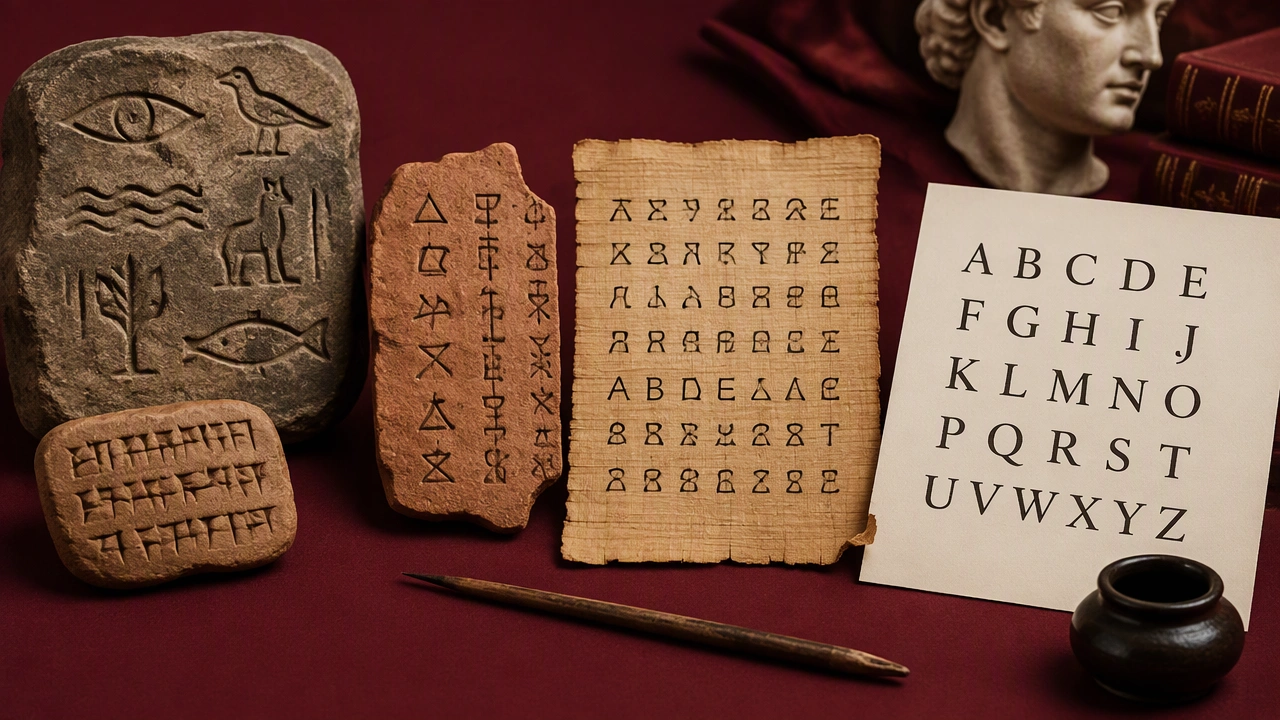
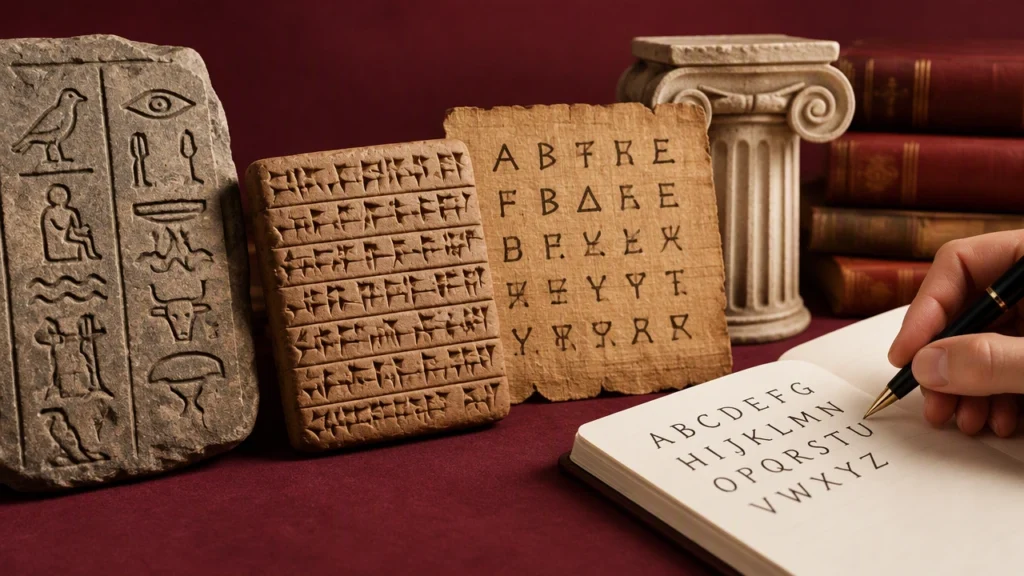
Long before alphabets, people recorded information with pictures and marks. A drawing of the sun could stand for the sun itself. A set of lines could count goods or days. These systems were often complex, and learning them took time. In ancient Mesopotamia, scribes pressed wedge-shaped marks into clay. In Egypt, hieroglyphs combined images with signs for sounds. In China, early characters developed into a lasting writing tradition. Each system solved the problem of preserving language, but none worked exactly like the alphabet we use now.
The important change came when writers began to focus on sounds rather than whole words or ideas. A sign no longer had to represent a complete object. It could represent a single speech sound, such as the first sound of a word. Once that principle took hold, a small set of signs could be reused to write many words.
The First Alphabetic Signs
The clearest early alphabet appeared among Semitic-speaking peoples in the Levant and Sinai region during the second millennium BCE. These signs were consonantal. They marked important consonant sounds while leaving vowels to be understood from context. This approach fits languages where consonant patterns carry much of the meaning. The signs were also economical: a limited set could cover the main sounds of speech.
Many of these early letters began as simplified pictures. The sign for an ox may have developed from a drawing of an ox head. A mark for water may have come from a wavy line. Over time, the pictures became abstract shapes. Scribes and engravers simplified them for speed, and different communities developed slightly different forms. The alphabet succeeded because it was easy to learn, easy to adapt, and easy to carry from one place to another.
From Semitic Consonants to Greek Vowels
Around the eighth century BCE, Greek writers adapted an earlier consonantal script for their own language. Greek had sounds that the source system did not mark directly, so the writers made a creative change. Some consonant signs were reassigned to represent vowels. This produced a full alphabet in which both consonants and vowels had clear signs.
The Greek alphabet also gained a steady direction of writing. Early scripts could run from right to left or in alternating lines. Greek writing settled into a left-to-right direction over time, and letter shapes turned to match. This is one reason some ancient letters appear reversed compared with earlier forms. The same sign can look different when its orientation changes.
How Latin Letters Took Shape
The Romans borrowed heavily from Greek writing, especially through contact with Etruscan neighbors in Italy. They adjusted the system to fit Latin sounds and created the set of letters that became the foundation of the English alphabet. Some letters were added or reshaped, while others were dropped when Latin did not need them. The letter J and the letter V developed later as distinct forms for sounds that earlier writers treated differently.
Roman inscriptions show the letters as firm, balanced shapes. Those carved forms influenced later handwriting, printing, and design. When printers in Europe standardized types in the fifteenth century, they drew on manuscript traditions that had preserved Roman letter forms for centuries. The letters we see in books, signs, and screens still carry traces of that history.
English and the Reused Alphabet
English uses the Latin alphabet, but English sounds do not fit the system perfectly. The language has vowels and consonant combinations that the original letters were not designed to show. As a result, English spelling often preserves history, borrowing patterns, and earlier pronunciations. Two letters can represent the same sound, and one letter can represent several sounds depending on the word.
This is why spelling can seem unpredictable. The alphabet is a practical tool, not a perfect map of speech. Dictionaries, style guides, and education help readers and writers navigate its inconsistencies. Even so, the basic system remains powerful: a small group of letters can build an enormous vocabulary.
Letters Across Time and Place
The journey of the alphabet did not stop with Rome. Different languages adapted the Latin letters to local needs. Some added marks above or below letters to show new sounds. Others combined letters or created new forms. Writers also changed letter shapes for handwriting, calligraphy, and printing. These changes show a recurring pattern: people keep the useful structure of an alphabet while adjusting its details.
Alphabets are not the only successful writing systems. Syllabaries, character-based scripts, and abjads continue to serve millions of readers. Each system reflects the sounds and habits of the language it records. The alphabet spread widely because it offered a compact way to represent speech, but it is one path among several.
What the Journey Teaches Us
The history of letters is a story of simplification, adaptation, and exchange. Ancient pictures became signs, signs became sound markers, and sound markers became the familiar letters of today. No single inventor created the whole system. Instead, generations of writers tested ideas, borrowed useful features, and passed them on.
When we ask where the alphabet letters came from, we are really asking how human communication learns to travel. A mark made for one purpose can cross a border, change its sound, and still remain recognizable. That flexibility is the alphabet’s greatest strength. It allows a child to learn a few symbols and then use them to read stories, record science, send messages, and preserve memory. The letters look simple because history has made them efficient.