Why Humans Invented Writing: General Learning from Clay, Papyrus, and Power
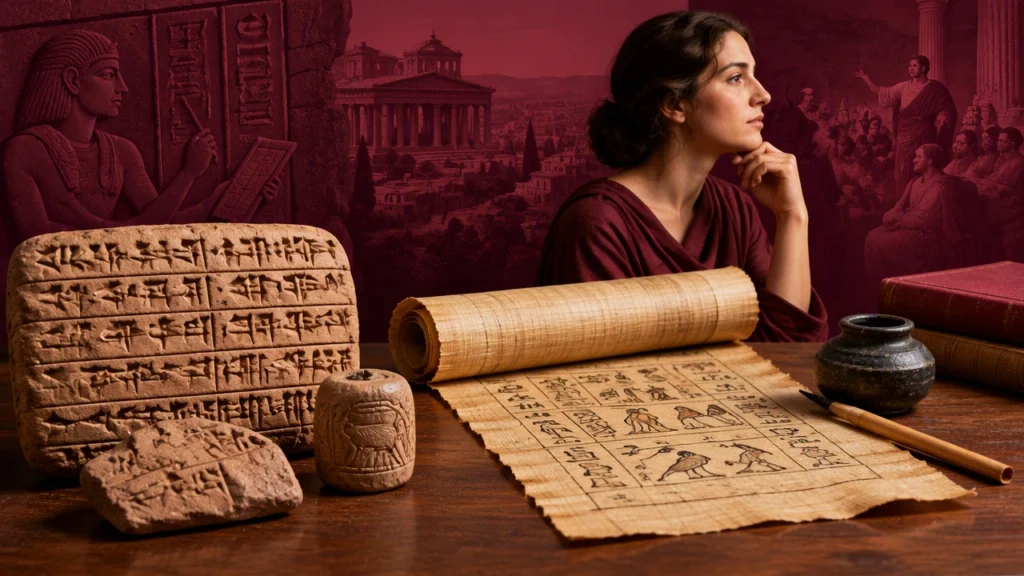
People often ask why did humans invent writing systems. The short answer is that societies needed a reliable way to hold information across time and distance. Marks on clay and papyrus did not appear as a sudden flash of genius. They grew from practical problems: counting goods, recording promises, keeping names, and organizing authority. Once people could store language outside the mind, trade, memory, and power changed shape in ways that still guide daily life.
Before writing: memory, tokens, and trusted people
Long before alphabets, communities relied on human memory and simple objects to manage information. Storytellers, elders, and specialists carried histories, genealogies, and rules in their heads. Merchants used small clay tokens to represent goods such as barley, oil, or cloth. These tokens worked well for small-scale exchange, but they depended on personal contact and shared understanding. When a community grew, when trade routes lengthened, and when agreements had to last beyond a single meeting, memory alone was not enough.
Marks on clay: lists, contracts, and the first archives
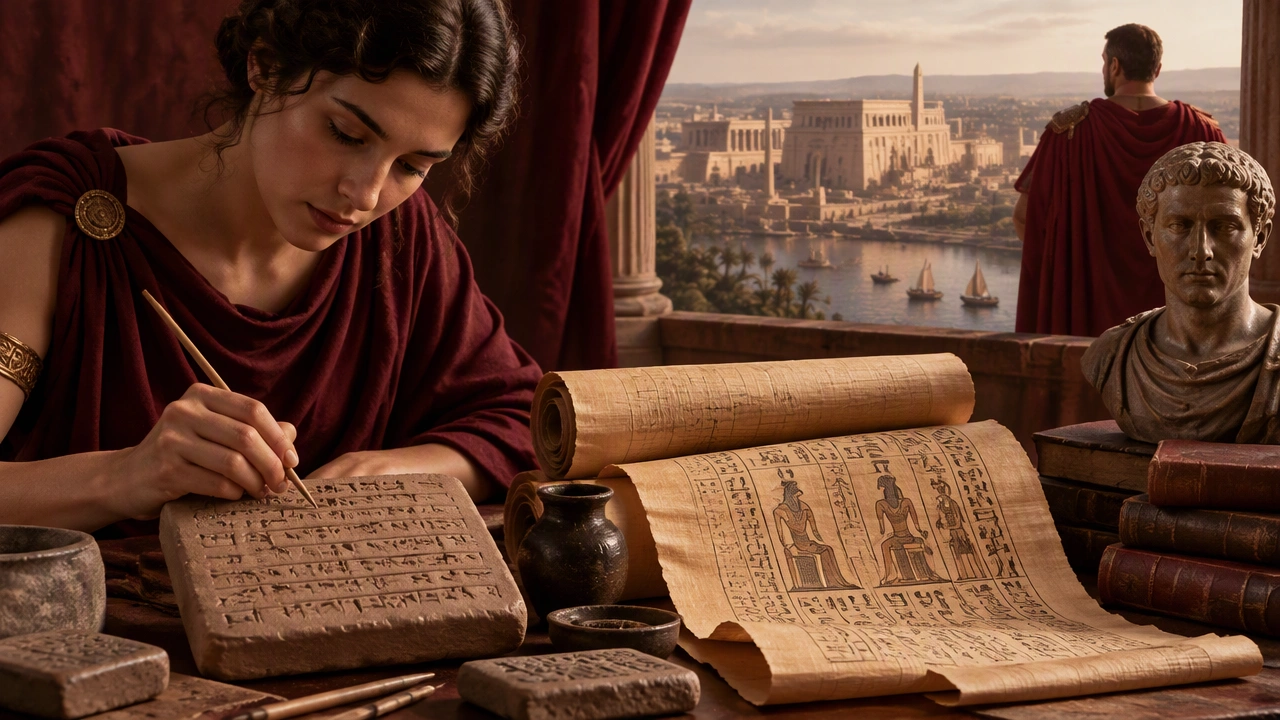
In Mesopotamia, scribes pressed wedge-shaped marks into soft clay tablets. Many early tablets were not poetry or philosophy. They were lists of rations, records of livestock, and notes about deliveries. Clay was cheap, abundant, and durable when dried or fired. A tablet could sit in a jar on a shelf and still be read years later. This simple durability changed trade. Merchants could document quantities, prices, and agreements. Officials could track taxes and storage. Temples and palaces could keep accounts that did not vanish when a worker moved on or a manager died.
Writing also made memory more stable. A community could preserve laws, rituals, and family lines in fixed form. Scribes standardized names, dates, and measures, which reduced disputes. When a contract existed in writing, people could point to it. Authority no longer rested only on the word of a local leader. It rested on a record that many could consult.
Papyrus and portable communication
Along the Nile, scribes used papyrus sheets made from plant fibers. Papyrus was lighter and more flexible than clay. It could be rolled into scrolls, carried by messengers, and stored in cabinets. Egypt used papyrus for tax lists, land records, letters, and administrative orders. Because papyrus traveled well, it helped officials govern larger territories. A royal decree could move down the Nile, reach a frontier office, and be copied for local use.
Papyrus also supported more connected trade. Merchants and tax collectors could send detailed instructions, receipts, and inventories. Writing became a tool for coordinating action across distance. A supplier in one town could confirm terms with a buyer in another without relying on rumor or memory.
How writing changed trade
Written records made exchange more predictable. Contracts fixed the amount, quality, and timing of goods. Witnesses could be named. Penalties could be stated. Debt could be tracked over months or years. This clarity encouraged longer trade networks and larger deals. Merchants could plan shipments, lenders could assess risk, and rulers could set consistent taxes. Weights, measures, and prices appeared in texts, which helped different markets speak the same commercial language.
Writing also created new professions. Scribes, accountants, and messengers formed systems that kept information flowing. Archives grew in temples, palaces, and merchant houses. With archives, people could compare past deals with current ones, notice patterns, and make better decisions.
How writing changed memory
Writing did not replace memory. It changed how communities used it. People still learned songs, stories, and skills. But writing allowed exact phrases, numbers, and lists to survive without constant recitation. Laws could be fixed so that judges applied the same rules across towns. Teachers could use texts to train students. Families could preserve names and property rights across generations.
Writing also expanded what counted as knowledge. Observations about the sky, seasons, and floods could be recorded, compared, and improved. Schools could pass technical methods from one cohort to the next. Knowledge became more cumulative because each generation could build on a stable written base.
How writing changed power
Rulers used writing to organize labor, collect taxes, and announce laws. Public inscriptions on stone declared royal deeds and divine support. Administrative tablets tracked workers, grain, and craft production. Writing made large institutions possible because it allowed orders and records to move beyond face-to-face contact.
Writing also shaped who held power. Literate elites managed archives and controlled access to records. Priests, scribes, and officials gained influence because they could read, write, and interpret texts. At the same time, writing gave subjects new ways to claim rights. A landholder with a deed could argue a case. A merchant with a contract could seek enforcement. Power remained unequal, but writing gave more people tools to negotiate within the system.
Why the invention stuck
Writing systems spread because they solved real problems. They reduced uncertainty in trade, preserved memory beyond a single lifetime, and supported administration across distance. Different regions developed different scripts, from cuneiform on clay to hieroglyphs and hieratic on papyrus, and later to alphabets on many surfaces. The forms varied, but the purpose stayed practical: to make language durable, portable, and shareable.
What this means today
Modern life still rests on the same foundation. Receipts, laws, maps, and contracts are descendants of early tablets and scrolls. Digital text is fast and searchable, but it serves the same goals: tracking exchange, preserving knowledge, and organizing authority. The question why did humans invent writing systems points to a basic human need. People wanted to make agreements that lasted, remember what mattered, and coordinate action beyond the reach of voice alone.
Marks on clay and papyrus did more than record words. They changed how humans trade, remember, and share power. In doing so, they made larger, more complex societies possible, and they continue to shape how we learn and govern today.